Your home-market success can become the reason you don’t sell in Japan
Most overseas brands considering Japan market entry have already succeeded at home. That’s exactly why it feels natural to take the best-selling copy, product page and ad creative, translate them into Japanese and use them as they are.
But that proven formula can be the very thing that trips you up in Japan. Even when the product itself is right, its value won’t come across if the way you communicate it doesn’t match how Japanese consumers think.
Every page and ad reflects the culture it was made for
When you create a product page or an ad, you reflect your own culture and habits, whether you mean to or not. Which words feel trustworthy? How much information feels like “enough”? Those standards differ from country to country.
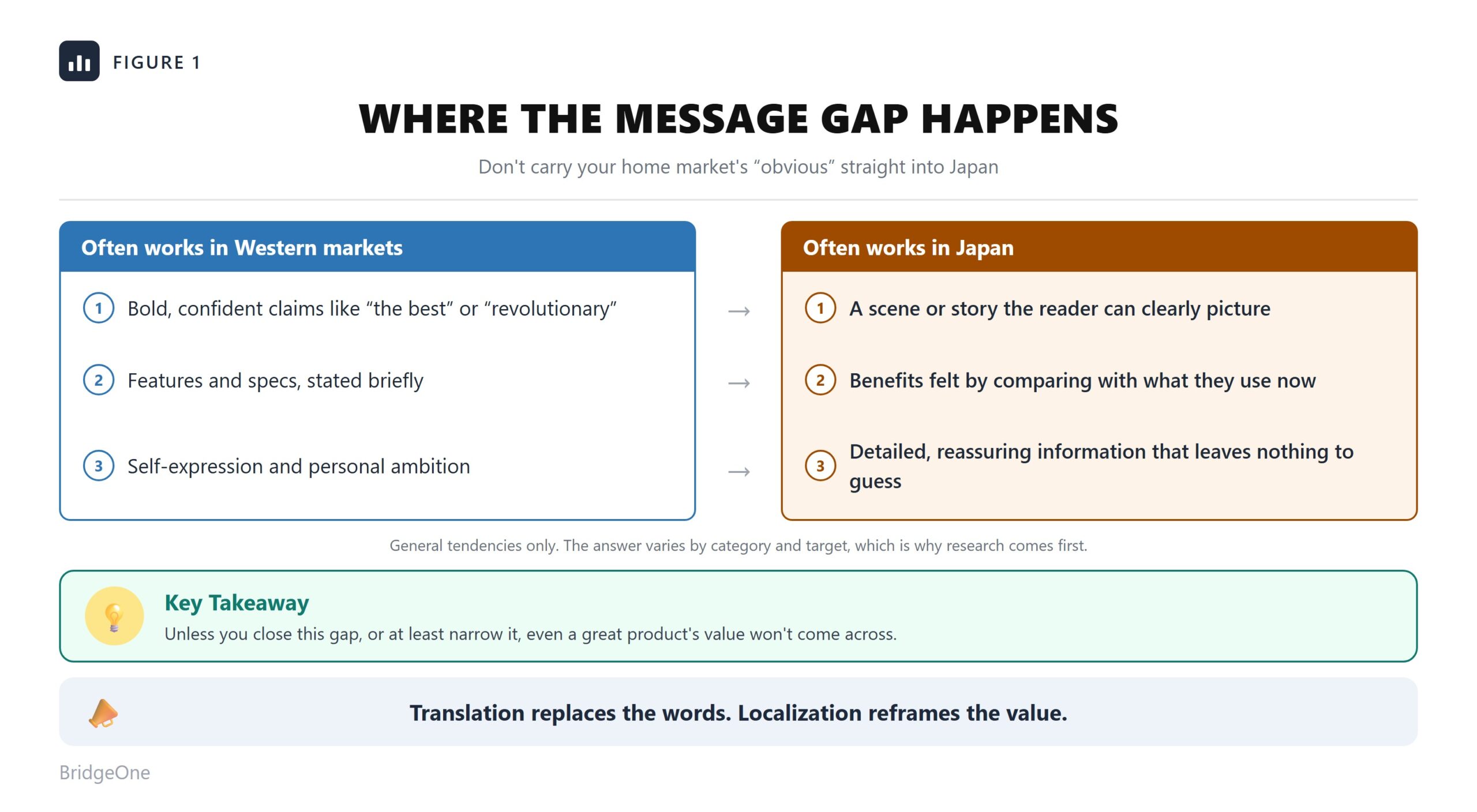
As general tendencies, the differences look like this.
What tends to work in Western markets
- Bold, confident claims like “the best” or “revolutionary”
- Features and specs, stated briefly
- Messages that champion self-expression and personal ambition
What tends to work in Japan
- A scene or story the reader can clearly picture themselves in
- Benefits they can feel by comparing with what they use now (before and after)
- Detailed, reassuring information that leaves nothing to guess
These are tendencies, not rules. The right answer changes with the product category and the target. That’s why what matters is closing this gap, or at least narrowing it. Leave it open, and even a great product won’t feel relevant to Japanese consumers.
Case study: ULTLLA, a Taiwanese folding umbrella, changed its message for Japan
Message gaps don’t only appear between the West and Asia. They appear between neighboring Asian markets, too.
Take ULTLLA, a folding umbrella from Taiwan that BridgeOne supported. Its biggest strength is its ultralight weight of 110g, and it ran a project on Makuake, Japan’s leading crowdfunding platform, in June 2026.
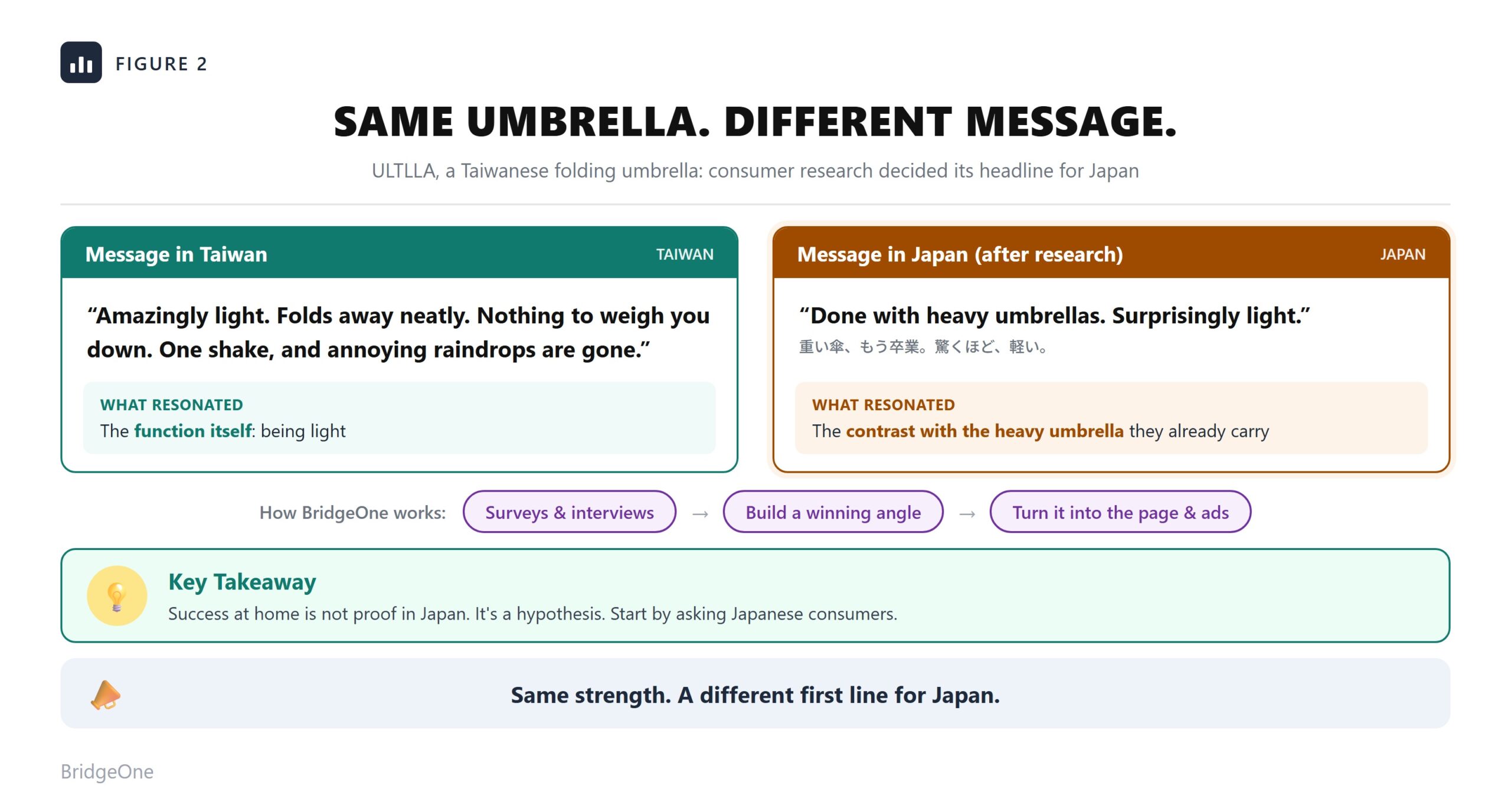
In Taiwan, the message was roughly:
“Amazingly light. Folds away neatly. Nothing to weigh you down. One shake, and annoying raindrops are gone.”
After running consumer research in Japan, the headline BridgeOne chose was:
“Done with heavy umbrellas. Surprisingly light.” (重い傘、もう卒業。驚くほど、軽い。)
Both messages communicate the same strength: lightness. But they landed differently.
- Taiwanese consumers valued the function itself: being light
- Japanese consumers valued the contrast with the heavy umbrella they already carry every day
It may look like a small difference. But it decides the first line of your page and the first line of your ads. And whether readers feel “this is about me” in that first line determines whether they keep reading.
Japanese consumers look for a scene they can picture
As the ULTLLA case shows, the key to communicating value to Japanese consumers is a story or situation they can picture concretely.
Telling them “it’s light” states a fact. Helping them picture “finally being free of the heavy umbrella in my bag every day” makes the value personal. The same feature can be received very differently depending on which scene you connect it to.
Translation vs. localization
Translation replaces the words. Localization reframes the value into a scene Japanese consumers can picture.
No matter how accurately you translate your home-market copy, it won’t resonate if the culture and habits behind it differ from Japan’s. Before deciding which words to use, you need to know where Japanese consumers see value in your product.
The most reliable way to find the gap: ask Japanese consumers
So how do you find this gap? The answer is simple. Ask Japanese consumers first.
A brand entering Japan has most likely already succeeded at home. But bringing that sense of success into Japan unchanged often leads to failure, and the main reason is not fully understanding how Japanese consumers think. Success at home is not proof in Japan. It’s a hypothesis.
As part of a group with over 25,000 research projects supported, BridgeOne conducts market research through surveys and interviews with a panel of about 82,000 consumer monitors. From there, we build Japan-ready messaging in four steps:
- Ask Japanese consumers: use surveys and interviews to learn where they see value and in which situations they’d use the product
- Build a winning angle: decide who to speak to, what to say and how to say it, based on the data
- Turn it into the page and ads: reflect the winning angle in the headline, page structure and ad creative
- Validate with real sales: use crowdfunding to test whether Japanese consumers actually pay for the product with that message
As an entry point for asking Japanese consumers first, BridgeOne offers the Japan Market Validation Service (JPY 50,000). Through a web survey of our consumer panel plus market and competitor analysis, we identify your product’s acceptance in Japan, target audience, price acceptance and key selling points, delivered as a Japan Market Fit Report with raw data (typically within 2 to 3 weeks). If you move on to the Japan Market Launch Service, this fee is effectively waived.
Frequently asked questions (FAQ)
Q. Isn’t translating our product page into Japanese enough?
A. In most cases, no. Translation replaces the words, but not the cultural assumptions behind the message. We recommend first learning where Japanese consumers see value, then redesigning the headline and page structure around it.
Q. Can we use the messaging that worked in our home market?
A. Sometimes, but it won’t necessarily work as is. As the ULTLLA case shows, even the same strength, lightness, can resonate more in Japan when framed differently. It’s safest to treat your home-market success as a hypothesis to test in Japan.
Q. How do you find messaging that works in Japan?
A. BridgeOne runs market research through surveys and interviews with our consumer panel, and builds a winning angle from the data. We then turn that angle into the product page and ads, and use crowdfunding to verify that it leads to real purchases.
Q. How much does the research cost, and how long does it take?
A. The Japan Market Validation Service is a fixed JPY 50,000, with delivery typically in 2 to 3 weeks. If you move on to the Japan Market Launch Service, this fee is effectively waived.
Q. Can we work with you without speaking Japanese?
A. Yes. All communication with BridgeOne can be done in English. If you prefer another language, we can also arrange an interpreter.
Turn your home-market success into success in Japan. If you want to find the message that resonates with Japanese consumers, start by asking them, and talk to BridgeOne.